
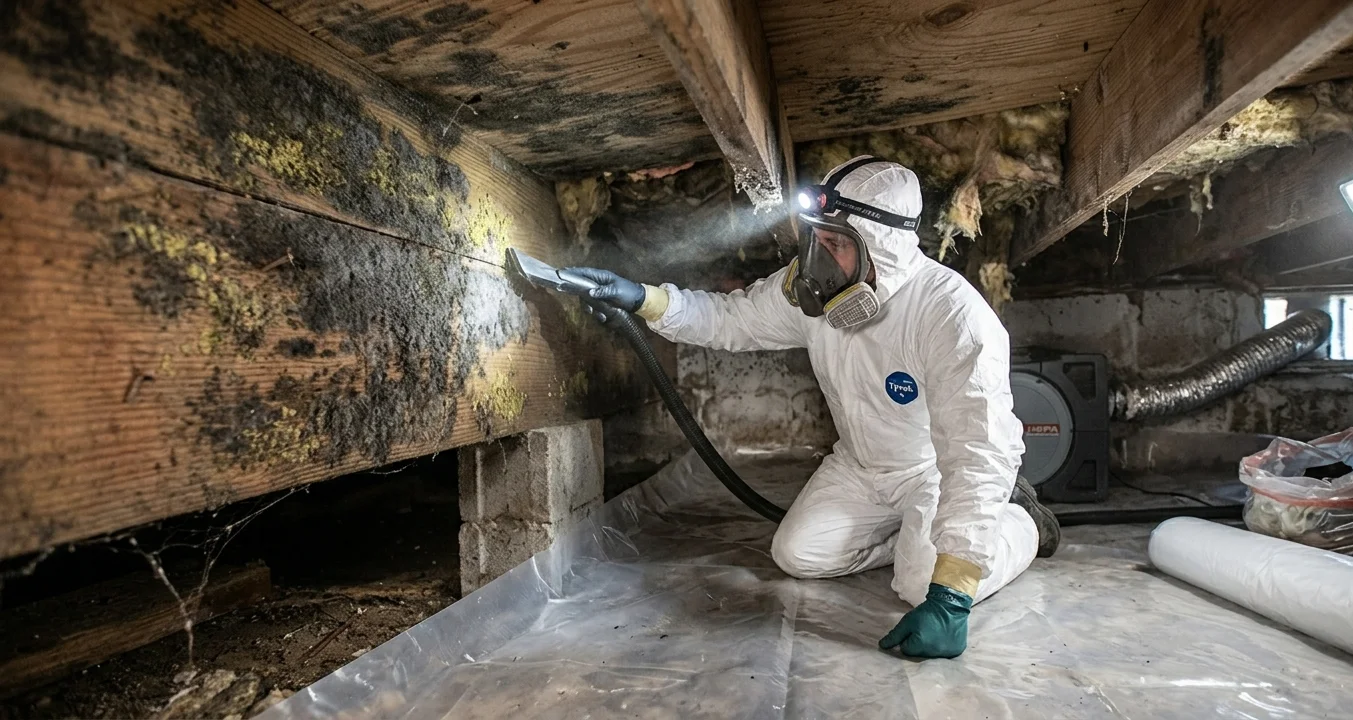
Most homeowners never look under their house. They deal with what they can see a leaky faucet, a cracked baseboard, a soft spot in the floor. What’s happening below the floor joists goes unnoticed for months, sometimes years.
By the time they do look, the crawl space tells a different story: dark staining across the wood, a thick musty smell that hits you at the access hatch, and joist surfaces that feel soft where they should be solid. That’s what active mold growth looks like in a crawl space and it rarely travels alone. Where there’s mold, there’s also elevated moisture, compromised wood, and the slow beginning of structural damage.
This blog covers everything you need to know: how to spot crawl space mold before it becomes a crisis, what it does to your home and your health if left alone, and what professional mold remediation service actually involves including the real difference between encapsulation and remediation, and why getting that distinction wrong is expensive.
QUICK ANSWER: Mold in a crawl space grows when relative humidity exceeds 60% and organic materials like wood joists and subfloor sheathing stay damp. Signs include a musty odor from floor vents, visible dark staining on joists, and soft or spongy flooring above.
Professional remediation not DIY bleaching is required for any colony covering more than 10 square feet, per EPA guidelines. Most crawl space mold jobs cost $2,000–$6,000 and include containment, HEPA vacuuming, antimicrobial treatment, and moisture barrier installation.
Why Crawl Spaces Are Mold’s Favorite Location
Crawl spaces are architecturally designed to be damp, dark, and still three things mold loves above everything else. Ground moisture evaporates upward through soil and concrete block, condensation forms on cold steel pipes and ductwork, and summer air loaded with humidity flows in through foundation vents that were designed to ventilate but often do the opposite in humid climates.
Add an organic food source wood joists, OSB sheathing, insulation kraft paper, cardboard and you have everything a mold colony needs to establish and spread. The problem compounds quickly: once relative humidity inside a crawl space exceeds 60% consistently, mold begins colonizing within days. In a Tennessee summer, unprotected crawl spaces routinely reach 80–90% relative humidity.
| 60% RH threshold for mold colonization | 48 hrs time to mold growth after water intrusion | 90%+ RH in unprotected TN crawl spaces in summer |
The Vented Crawl Space Problem
For decades, building codes required foundation vents on the theory that outdoor air would dry out the crawl space. In dry climates, it works. In humid climates like the mid-South, it backfires: warm, moisture-laden summer air flows in, hits the cooler surfaces below the house, and drops its moisture load exactly where you don’t want it. Vented crawl spaces in Tennessee are often the source of the problem, not the solution.
This is why modern remediation almost always includes either partial or full encapsulation converting the crawl space to a sealed, conditioned environment that breaks the cycle of seasonal moisture intrusion.
Now its time to call a expert for crawl space cleaning services.
Signs of Mold in a Crawl Space
The tricky thing about crawl space mold is that most of its warning and early signs of mold are above-ground inside the living spaces of your home. By the time you notice something, the colony below may already be well-established.
Signs You Can Detect From Inside Your Home
- Persistent musty or earthy odor — especially noticeable near floor vents, under-stair closets, or first-floor bathrooms; the smell intensifies in summer
- Unexplained allergy or respiratory symptoms — chronic congestion, coughing, or eye irritation that improves when you’re away from home for several days
- Soft, spongy, or uneven flooring — especially near exterior walls; a sign that subfloor sheathing has begun to absorb moisture and may be developing early wood rot
- Visible condensation on first-floor windows — in summer, a sign that indoor humidity is being driven up by moisture migrating from below
- Increased energy bills — compromised insulation from moisture intrusion reduces thermal efficiency, forcing HVAC systems to work harder.
Signs Visible in the Crawl Space Itself
- Dark staining on joist faces, bridging, or subfloor — typically appears as black, grey-green, or white fuzzy growth running along wood grain
- Efflorescence on concrete block walls — white mineral deposits that indicate chronic moisture migration through the foundation
- Sagging or discolored insulation — insulation batts that have absorbed moisture and pulled away from the joist cavities
- Standing water or wet soil — even seasonal standing water creates conditions that sustain mold through the full humid season
- Rust on metal components — HVAC ductwork, steel bridging, and fasteners that show orange rust are evidence of sustained high humidity.
Get professional mold inspection services.
PRO TIP: THE SMELL TEST: Open your floor registers on a warm, humid day in July. If the air coming up has a distinctly musty, earthy smell even faintly schedule a crawl space inspection. That odor is almost always biological. You’re smelling microbial volatile organic compounds (MVOCs) produced by active mold colonies. It doesn’t smell like that in a clean, dry crawl space.
Health Risks and Structural Damage
Crawl space mold presents two distinct categories of risk: health effects from spore and mycotoxin exposure, and structural deterioration from wood rot and moisture damage. Both are serious, and both escalate over time.
Health Risks
Mold spores from crawl spaces migrate into living areas through the stack effect the natural tendency of air to move upward through a building. Studies suggest that up to 40% of the air in a home’s living areas originates from the crawl space below. This means an active mold colony under your floor is continuously seeding the air you breathe inside your home.
Common health effects from crawl space mold exposure include respiratory irritation, chronic sinusitis, asthma exacerbation, and fatigue. Children, elderly residents, and people with compromised immune systems are disproportionately affected.
In cases involving Stachybotrys chartarum (black mold) or high concentrations of Aspergillus/Penicillium species, more serious neurological and systemic effects have been documented in prolonged exposure scenarios.
Structural Damage: Wood Rot and Joist Failure
Wood rot is the long-term consequence of sustained moisture and mold activity on structural timber. It comes in two primary forms:
- Brown rot (cubical rot) — breaks down cellulose in the wood, leaving a brown, crumbling residue; severely compromises load-bearing capacity of joists and beams
- White rot — breaks down both cellulose and lignin; wood becomes white, stringy, and spongy; most common in high-humidity crawl spaces
Both types of wood rot are caused by specific fungal species distinct from the mold species typically associated with health effects, but often present simultaneously in the same environment. A crawl space with active mold growth is almost always also developing some degree of wood rot in the structural members.
Left untreated, joist damage progresses from surface staining to core degradation, to the point where joists no longer meet load specifications. This is when floors begin to feel soft, furniture causes floor deflection, and in severe cases structural failure becomes a safety concern.
IMPORTANT: MOLD + WOOD ROT = TWO SEPARATE PROBLEMS: Mold remediation addresses the active biological growth. It does not repair wood rot damage that has already occurred. If joists show significant cross-section loss or structural degradation, a licensed structural contractor must evaluate and potentially sister or replace the affected members after remediation is complete. Many homeowners don’t realize this until after the remediation bill is paid.
Crawl Space Encapsulation vs. Remediation: The Key Difference
These two terms get used interchangeably online and that confusion leads homeowners to hire the wrong service, spend money on the wrong solution, or skip a critical step entirely.
| REMEDIATION — Removes the Problem: Kills and removes active mold colonies HEPA vacuuming of spores from surfaces Antimicrobial treatment of structural members Removal of contaminated materials (insulation, debris)Required BEFORE: encapsulation can begin Addresses the biological contamination | ENCAPSULATION — Prevents Recurrence: Installs a heavy-duty vapor barrier over soil and walls Seals foundation vents to stop humid air infiltration Adds a dehumidifier to control ongoing RH levels Turns crawl space into a dry, sealed environment Done: AFTER remediation, not instead of it Addresses the moisture source long-term |
The most common mistake: homeowners (and some contractors) encapsulate over active mold growth, sealing the problem inside the barrier rather than eliminating it first. The mold continues to grow in the dark, sealed environment. When the vapor barrier is eventually lifted during a plumbing repair or a home inspection the colony is far larger than when it was sealed in.
The correct sequence is always: remediate first, verify clearance with air testing, then encapsulate. In that order. Every time.
Crawl Space Mold Removal Cost Guide
Cost varies based on square footage, severity of contamination, whether structural repairs are needed, and whether encapsulation is included. You should also know about crawl space encapsulation costs.
Here’s a realistic breakdown for Tennessee and the mid-South region.
| Scope | Typical Cost Range | What’s Included |
| Basic remediation only (under 500 sq ft, surface mold) | $1,200 – $2,500 | HEPA cleaning, antimicrobial treatment, debris removal |
| Remediation with insulation removal and reinstall | $2,000 – $4,000 | All of above + insulation pull-and-replace |
| Full remediation + vapor barrier installation | $3,000 – $6,000 | Remediation + 20-mil vapor barrier, vent sealing |
| Full encapsulation with dehumidifier installation | $4,500 – $9,000 | Complete sealed crawl space system with humidity control |
| Post-remediation clearance testing (3rd party) | $300 – $600 | Air sampling, lab analysis, written clearance letter |
| Structural joist sistering (if rot present) | $1,500 – $5,000+ | Structural repair by licensed contractor after remediation |
Does Homeowners Insurance Cover Crawl Space Mold?
In most cases, standard HO-3 policies cover mold remediation only when it results directly from a sudden, covered water event such as a burst pipe that was promptly reported. Mold that developed gradually from ground moisture, humidity, or poor ventilation is almost universally excluded. Flood damage requires a separate NFIP flood policy.
Document everything with photos, file quickly, and push back in writing if denied. If your crawl space mold is connected to a plumbing event or a roof leak, you have a stronger case than most homeowners realize especially with a public adjuster in your corner.
Crawl Space Moisture Control: Long-Term Prevention
Remediation fixes what’s there now. These measures prevent it from coming back.
- Maintain relative humidity below 55% year-round — a dedicated crawl space dehumidifier with a drain line is far more effective than a portable unit emptied manually
- Install a 20-mil reinforced vapor barrier — thinner 6-mil plastic degrades, tears at seams, and allows ground moisture to migrate through; the upgrade in barrier thickness is worth every dollar
- Seal all foundation vents — in Tennessee’s climate, vented crawl spaces are a liability; sealed and conditioned crawl spaces maintain dramatically lower humidity levels
- Redirect exterior drainage away from the foundation — ensure gutters discharge at least 6 feet from the foundation; grade soil away from the house at a minimum 6-inch drop over 10 feet
- Inspect plumbing penetrations annually — condensation lines, drain pipes, and water supply lines that drip or sweat inside the crawl space are common moisture contributors that go unnoticed
- Check the crawl space after every significant rain event — standing water after heavy rain indicates a drainage problem that will keep reseeding moisture into the crawl space regardless of the barrier
TENNESSEE SUMMER NOTE: From May through September, outdoor dewpoint temperatures in Middle and East Tennessee regularly exceed 65°F which means outdoor air introduced into a crawl space carries enough moisture to raise RH above 80% within hours on a hot afternoon. This is why passive venting fails in this climate. If your crawl space doesn’t have a dehumidifier and a sealed vapor barrier, mold season is already underway every summer whether you can see it or not.
Frequently Asked Questions
Q: How do I know if I have mold in my crawl space without going under the house?
A: The most reliable above-ground indicators are a persistent musty odor from floor vents or under-stair closets, unexplained respiratory symptoms that improve when you leave the house, and soft or spongy areas in your flooring. A professional inspection with a borescope camera can confirm mold growth without requiring full crawl space entry.
Q: Can I remove crawl space mold myself?
A: The EPA recommends professional remediation for any mold area exceeding 10 square feet. Crawl space mold almost always exceeds this threshold, and working in a confined space with disturbed mold colonies without proper PPE and negative air pressure creates serious health risks. DIY attempts also typically miss the full extent of the colony, leading to rapid recurrence.
Q: What is the difference between crawl space encapsulation and mold remediation?
A: Remediation removes active mold growth through physical removal, HEPA vacuuming, and antimicrobial treatment. Encapsulation installs a sealed vapor barrier system to prevent future moisture intrusion. They are sequential steps, not alternatives. Encapsulating over active mold seals the problem in and accelerates damage. Remediation must always come first.
Q: How much does crawl space mold remediation cost?
A: Most crawl space mold remediation projects in Tennessee cost between $2,000 and $6,000, depending on affected square footage, contamination severity, and whether encapsulation is included. Adding a full vapor barrier and dehumidifier system typically runs an additional $2,000 to $4,000. Structural joist repairs, when needed, are scoped and priced separately.
Q: How long does crawl space mold remediation take?
A: A typical crawl space project takes 1 to 3 days for remediation, followed by a 2- to 5-day wait for post-remediation air test results. Vapor barrier and encapsulation work adds another 1 to 2 days. The full process from initial inspection to final clearance typically spans 1 to 2 weeks.
Q: Will mold in my crawl space come back after remediation?
A: Not if the moisture source is properly addressed. Mold does not regenerate in a dry environment. Remediation that is followed by a properly installed vapor barrier and a functioning dehumidifier maintained at or below 55% relative humidity should not recur. Recurrence almost always indicates either an incomplete remediation job or an unresolved moisture intrusion that was not part of the original scope.
Think You Have Mold in Your Crawl Space?
Don’t guess. Our IICRC-certified team provides free crawl space inspections across Tennessee. We’ll tell you exactly what’s down there no upsells, no pressure, no surprises.
CALL (423) 802-6910 · Free Crawl Space Check · 24/7 AVAILABLE restorablesolutions.com
WRITTEN BY
Restorable Solutions Restoration Team : IICRC Certified · AMRT · WRT · ASD · Est. 2009 · Tullahoma, TN Our certified technicians have inspected and remediated hundreds of crawl spaces across Tennessee and the Southeast. We hold IICRC certifications in Applied Microbial Remediation (AMRT), Water Damage Restoration (WRT), and Applied Structural Drying (ASD). We’ve seen what moisture does to a home from the ground up and we know how to stop it.