
⚡ QUICK ANSWER:
What Is Water Damage Restoration?
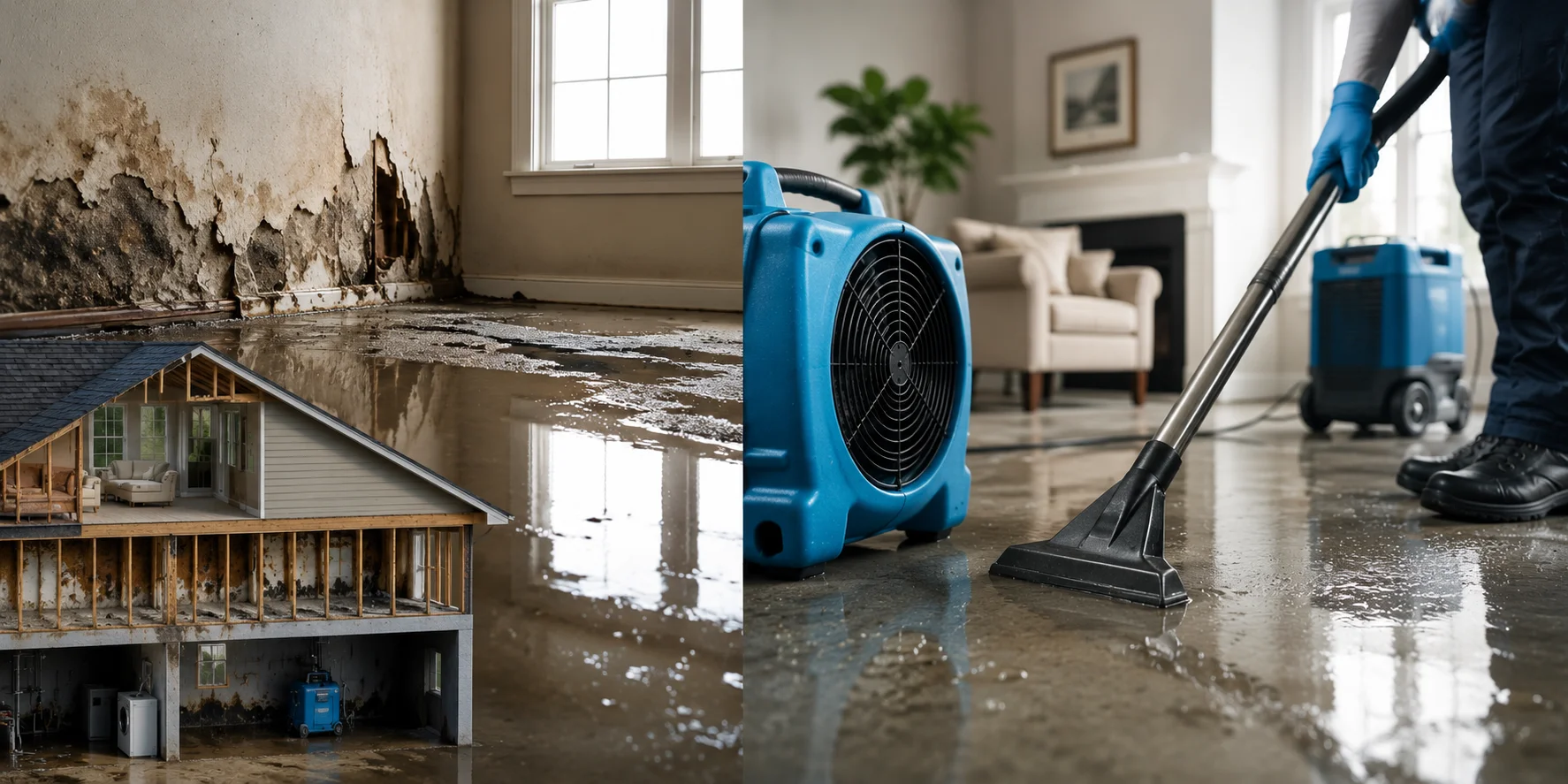
Water damage restoration is the process of removing water, drying affected materials, preventing mold growth, and restoring a property to its pre-loss condition. Professional restoration includes water extraction, dehumidification, structural drying, moisture mitigation, sanitization, and repairs to protect your home from long-term damage.
A complete water damage restoration project may include:
- Emergency water removal
- Water extraction
- Structural drying
- Moisture detection
- Damaged material removal
- Mold prevention
- Sanitization and cleaning
- Repairs and reconstruction
Professional restoration companies follow guidelines established by organizations such as the IICRC (Institute of Inspection Cleaning and Restoration Certification) and RIA (Restoration Industry Association) to ensure effective and safe restoration practices.
Need immediate help? Visit our Water Damage Restoration Service page to learn how our team handles emergency water extraction, drying, cleanup, and full property restoration.
Water Damage Restoration at a Glance
| Question | Quick Answer |
|---|---|
| What is water damage restoration? | Professional cleanup, drying, and repair after water intrusion. |
| How quickly should it begin? | Within 24 hours. |
| Can mold grow after water damage? | Yes, often within 24-48 hours. |
| How long does drying take? | Typically 3-7 days. |
| Does insurance cover it? | Often yes, depending on the cause. |
| When should you call professionals? | Immediately after flooding, leaks, or standing water. |
Common Causes of Water Damage
Water damage is the second most common home insurance claim in the United States. Understanding its most frequent sources helps you both prevent it and recognize it early.
Plumbing Failures
Burst pipes, corroded supply lines, loose fittings, and failed toilet fill valves account for the majority of interior water damage. These events often occur inside walls, under slabs, or above drop ceilings where water runs for hours before anyone notices.
Appliance Leaks
Washing machines, dishwashers, refrigerator ice makers, and water heaters are among the most common sources of home water damage. A washing machine supply hose that fails at full pressure can discharge dozens of gallons per minute directly onto a finished floor.
Roof and Attic Leaks
Damaged shingles, failed flashing, and clogged gutters allow water into roof assemblies, where it travels through framing before appearing as a ceiling stain. By the time the stain is visible, the framing above may already have significant moisture damage and the early stages of mold growth.
Flooding and Storm Surge
Heavy rain, overflowing gutters, and inadequate yard drainage push water against foundations and through slab cracks. That where you need to foundation repair. This water is classified as Category 3 — black water carrying soil bacteria and contaminants that require professional-level cleanup and disposal protocols.
Sewage Backups
A blocked sewer main or failed sump pump can send raw sewage into basements and lower levels. However proper Sum pump installation matter but sewage backup is the most serious category of water damage and cannot be safely cleaned without professional equipment, containment, and EPA-compliant disposal procedures.
What To Do Immediately After Water Damage
First 30 Minutes
- Shut off the water source if possible.
- Turn off electricity in affected areas.
- Move valuables to a dry location.
- Contact a professional water damage restoration company.
Within 24 Hours
- Begin emergency water removal.
- Document damage for insurance.
- Start drying and dehumidification.
- Remove wet materials if instructed by professionals.
Avoid These Mistakes
- Using household fans alone.
- Ignoring hidden moisture.
- Waiting several days before cleanup.
- Entering contaminated floodwater without protection.
Understanding Water Categories (IICRC Classification)
The IICRC (Institute of Inspection Cleaning and Restoration Certification) classifies water damage into three categories based on contamination level. This classification drives the entire cleanup approach.
| Category | What It Means | Common Sources |
| Cat. 1 — Clean | Safe at source; no contaminants | Burst supply line, overflowing sink, rain intrusion through roof |
| Cat. 2 — Grey | Contaminants present; health risk if ingested | Dishwasher overflow, washing machine leak, sump pump failure |
| Cat. 3 — Black | Sewage or floodwater; serious health hazard | Sewage backup, rising floodwater, toilet overflow with waste |
Signs of Hidden Water Damage
Not all water damage is obvious. Some of the most expensive damage is hidden inside walls, under floors, or above ceilings growing unchecked for weeks. These are the warning signs you should never ignore.
- Ceiling stains or brown rings — yellowish or brown marks with a defined ring edge; the ring forms where water has dried and left behind dissolved minerals
- Bubbling, peeling, or warped paint — moisture trapped beneath paint separates it from the drywall; a reliable indicator of active moisture behind the surface
- Soft or spongy drywall — damaged drywall that has absorbed water loses rigidity; press along baseboard areas and below windowsills for early detection
- Persistent musty odor — the smell of microbial volatile organic compounds (MVOCs) from active mold colonies present even before any visible growth appears
- Warped or buckled flooring — hardwood and laminate floors absorb moisture and expand; soft spots, cupping, or visible buckling indicate subfloor saturation
- Unexplained water bill increase — a slow pipe leak may register only as a 15 to 20 percent rise in monthly water usage before any visible surface damage appears
- Rust on pipes or fixtures — surface rust in otherwise dry areas indicates chronic condensation or a slow seep nearby that deserves investigation.
| PROFESSIONAL MOISTURE DETECTION: Professional water damage technicians use non-invasive moisture meters and thermal imaging cameras to locate water trapped inside wall cavities, under flooring, and in ceiling assemblies without cutting anything open. If you suspect hidden water damage anywhere in your home, professional moisture detection pays for itself many times over compared with finding an established mold problem months later. |
Equipment Used During Water Damage Restoration
Professional restoration companies commonly use:
- Commercial water extractors
- Air movers
- Industrial dehumidifiers
- Moisture meters
- Thermal imaging cameras
- HEPA air scrubbers
These tools help identify hidden moisture and accelerate structural drying.
DIY vs Professional Water Damage Restoration
| Factor | DIY Cleanup | Professional Restoration |
|---|---|---|
| Water Removal | Limited | Advanced extraction equipment |
| Drying Speed | Slow | Fast |
| Hidden Moisture Detection | Difficult | Thermal imaging & meters |
| Mold Prevention | Limited | Professional treatment |
| Insurance Documentation | No | Yes |
| Long-Term Protection | Moderate | High |
| HOW LONG DOES STRUCTURAL DRYING TAKE? A properly equipped professional drying job typically takes 3 to 5 days for moderate water damage. Larger events, Category 3 contamination, or damage spanning multiple floors can extend drying to 7 to 10 days. Any company promising same-day completion for significant structural water damage should be questioned carefully. |
How to Choose the Best Water Damage Restoration Company?
Look for:
- IICRC-certified technicians
- 24/7 emergency response
- Insurance claim assistance
- Advanced drying equipment
- Positive customer reviews
- Local service availability
If you’re searching for “water damage restoration near me,” choose a company that can arrive quickly and begin emergency water extraction immediately. Delays often increase repair costs and mold risks.
Complete Water Damage Restoration Steps
Professional water damage restoration follows a structured sequence. Here’s the full process from the moment a crew arrives to the day your home is returned to normal.
- Emergency response and moisture assessment — IICRC-certified technicians document moisture readings, identify water source and category, and define the scope of affected areas
- Source mitigation — if a plumbing failure caused the event, the crew coordinates with a licensed plumber to confirm the source is stopped before restoration begins
- Commercial water extraction — truck-mounted or portable extractors remove standing water and surface moisture from all flooring and subfloor materials
- Controlled demolition — wet and unsalvageable materials are removed strategically to expose structural assemblies for complete drying access
- Drying equipment placement — IICRC-calculated quantities of commercial dehumidifiers, air movers, and air scrubbers (for Category 2/3 events) are deployed
- Daily moisture monitoring — technicians return each day to log readings, adjust equipment placement, and confirm drying progress toward established goals
- Antimicrobial application — EPA-registered fungicides applied to all previously wet surfaces after confirmed drying provides residual mold protection
- Clearance verification — final moisture readings confirm all materials have reached pre-loss equilibrium before reconstruction begins
- Reconstruction and finishing — drywall installation, painting, flooring replacement, and cosmetic repairs return the space to pre-loss condition
Insurance and Documentation Tips
This is where homeowners most often leave money on the table or lose it entirely. Here’s what experienced restoration professionals recommend when navigating a water damage insurance claim.
Document Before Anything Is Touched
Photograph and video every affected area, every damaged item, and every visible water intrusion point before any cleanup begins. Capture wide-angle room shots, close-ups of material damage, and floor-level views showing water height. This visual record is the foundation of your claim and cannot be reconstructed after the fact.
Understand Your Coverage
Standard HO-3 homeowners policies cover sudden and accidental internal water damage — burst pipes, appliance failures, storm-driven roof leaks. They almost never cover flooding from outside the home (which requires a separate NFIP flood policy) or gradual damage from slow leaks that could have been detected and repaired.
Work With a Licensed Restoration Company
Reputable restoration companies produce the detailed moisture logs, drying reports, and scope-of-work documentation that insurance adjusters require. This professional documentation is often the difference between a full settlement and a significantly underpaid claim.
File Quickly and Follow Up in Writing
Most policies require you to report damage promptly and take reasonable steps to prevent further loss. Delays in filing or delays in starting mitigation can give an insurer grounds to reduce or deny a claim. Follow up every call with an email to create a written record.
Push Back on Denials
If your claim is denied or underpaid, request the specific policy language supporting the denial in writing. Many initial denials are successfully overturned on appeal, especially when damage is clearly connected to a covered peril and supported by professional documentation.
Water Damage Restoration Cost Guide (Tennessee & Southeast)
Costs vary by area affected, water category, and whether reconstruction is required. Here are realistic ranges based on what we see in our market.
| Damage Scope | Typical Cost | What’s Included |
| Small leak, single room (minor) | $1,000 – $3,000 | Extraction, drying, minor repairs |
| Multiple rooms, moderate damage | $3,000 – $8,000 | Full extraction, structural drying, drywall repair |
| Flooding — finished basement | $5,000 – $15,000+ | Demolition, extraction, drying, full restoration |
| Sewage backup (Category 3) | $3,000 – $10,000 | Biohazard remediation, sanitization, rebuild |
| Emergency water extraction only | $500 – $2,500 | Pump-out, initial dry-down, containment |
Frequently Asked Questions
Q: How quickly does water damage need to be addressed?
A: Ideally within 1 to 2 hours of discovery. Mold begins growing in 24 to 48 hours, and drywall, insulation, and wood framing absorb water continuously until extraction begins. Every hour of delay increases both the scope of drying required and the likelihood of secondary mold damage.
Q: Can I handle water damage cleanup myself?
A: Minor surface moisture on non-porous materials in a well-ventilated space can sometimes be managed with consumer equipment. Any event involving structural framing, wall cavities, subfloor materials, or Category 2/3 water requires professional equipment and expertise. The hidden cost of incomplete drying mold remediation months later almost always exceeds what professional mitigation would have cost initially.
Q: What is the difference between water mitigation and water damage restoration?
A: Water mitigation is the emergency phase: stopping damage, extracting water, and drying structural materials to prevent mold. Water damage restoration is the full scope including reconstruction and returning the property to pre-loss condition. Mitigation happens first and is the more time-critical of the two phases.
Q: How long does water damage restoration take?
A: The drying phase for a moderate residential event typically takes 3 to 5 days with professional equipment. Reconstruction replacing drywall, flooring, and finishes adds additional time depending on scope. A small contained event might be fully restored in a week; a major flood can require 4 to 6 weeks from start to finish.
Q: Does homeowners insurance cover water damage?
A: Standard HO-3 policies cover sudden and accidental water damage from internal sources burst pipes, appliance failures, and certain storm-related roof leaks. Flood damage from outside the home requires a separate NFIP flood insurance policy. Gradual damage from slow leaks is typically excluded. Filing quickly with thorough documentation significantly improves claim outcomes.
Q: How do I know if water damage has caused mold?
A: Signs of mold following water damage include a persistent musty odor that remains after the area appears dry, visible dark staining on drywall or wood, surface growth that returns within weeks of cleaning, and household members experiencing respiratory symptoms that improve when they leave the home. Professional air and surface sampling provides the only definitive confirmation.
| Dealing With Water Damage Right Now? Don’t wait. Every hour of standing water doubles the risk of mold, structural damage, and a larger repair bill. Our IICRC-certified crew responds 24/7 across Tennessee with the equipment, training, and experience to stop the damage and get your home back to normal. CALL (423) 802-6910 · 24/7 EMERGENCY LINE · FREE INSPECTION. |
WRITTEN BY:
Restorable Solutions Restoration Team IICRC Certified · WRT · ASD · AMRT · Est. 2009 · Tullahoma, TN We are a locally owned, IICRC-certified water damage and mold restoration company with over 15 years of experience serving homeowners and businesses across Tennessee.
This Blog was reviewed by water damage restoration professionals with experience in emergency water removal, structural drying, moisture mitigation, and mold prevention. Industry best practices referenced throughout this article align with standards developed by the IICRC and restoration industry guidelines.